
-
Capabilities, Human Nature, and Liberalism
Leggi tutto: Capabilities, Human Nature, and LiberalismDespite being considered one of the most promising theories of justice, Martha Nussbaum’s capabilities approach (CA) has faced significant objections from liberal scholars. This article reconstructs and addresses three major critiques: that an exclusive focus on capabilities rather than functioning is ineffective in protecting people’s well-being; that the CA is paternalistic; and that it relies on a vague notion of human nature. I argue that, although Nussbaum’s account has the resources to respond to these objections, incorporating John Stuart Mill’s harm principle offers a more…
-
Forgetting at the edge of chaos: Chaotic perturbations for selective machine unlearning
Leggi tutto: Forgetting at the edge of chaos: Chaotic perturbations for selective machine unlearningMachine unlearning has emerged as a key requirement for modern machine learning systems, driven by privacy regulations and the growing need to remove specific training data from deployed models. Current methods attempt to forget information while preserving the utility of the remaining knowledge. Despite recent progress, effective forgetting in deep neural networks remains difficult. Existing approaches often rely on costly retraining, or on perturbation-based methods that, while more efficient, can erase targeted information at the cost of damaging retained representations and degrading model behavior. As…
-
TRACE: Transparent representation auditing via concept extraction
Leggi tutto: TRACE: Transparent representation auditing via concept extractionModern vision models often achieve strong average predictive performance but can exhibit substantial disparities across demographic and contextual groups, visual attributes, or environmental contexts that are hidden by aggregate metrics. Existing auditing approaches typically rely on predefined demographic annotations or manually specified groups, limiting their ability to uncover previously unknown sources of bias. Consequently, important model failures may remain concealed within latent populations not captured by available metadata. We propose TRACE, an auditing framework that combines mechanistic interpretability with subgroup discovery, without access to the…
-
Artificial intelligence and Women’s Work: a Review of evidence
Leggi tutto: Artificial intelligence and Women’s Work: a Review of evidenceArtificial intelligence is reshaping the labor market, with effects that vary by sector, skill level, and gender.The literature paints an ambivalent picture. Artificial intelligence has favored women’s employment in some contexts, but they remain exposed to biased algorithmic systems, underrepresented in technology-intensive professions, and significantly less likely to adopt generative AI tools.This vision paper summarizes existing literature on the impact of AI on women in the labor market across three interconnected themes: the gendered impact of AI on employment and skill demand; gender bias embedded…
-
HydroChronos: Forecasting long-term surface water dynamics from multi-modal data
Leggi tutto: HydroChronos: Forecasting long-term surface water dynamics from multi-modal dataForecasting surface water dynamics is essential for water resource management and climate change adaptation, but progress is limited by the scarcity of large-scale benchmarks and by the lack of insight into how multi-modal models combine satellite, climate, and topographic signals. In this paper, we provide a detailed characterization of HydroChronos, a large-scale multi-modal spatiotemporal dataset for surface water forecasting that spans over three decades of aligned Landsat 5 and Sentinel-2 imagery, climate variables, and Digital Elevation Models across lakes and rivers in Europe, North America,…
-
Descriptor: Context-Aware Collaborative Perception in Autonomous Driving Dataset (ConVeX)
Leggi tutto: Descriptor: Context-Aware Collaborative Perception in Autonomous Driving Dataset (ConVeX)Collaborative perception (CP), using vehicle-to-everything (V2X) communication to share sensor data between connected vehicles and between the latter and the network infrastructure, has emerged as a prominent solution to extend the view of single autonomous vehicles. The effectiveness of this paradigm, however, may be hindered by the presence of adverse weather conditions and changes in lighting, often affecting real-world scenarios. Thus, assessing the robustness of CP to environmental contingencies is still an open issue. Importantly, although some large-scale datasets for CP, comprising realistic and simulated…
-
Webfare: trasformare la sorveglianza in nuova solidarietà
Leggi tutto: Webfare: trasformare la sorveglianza in nuova solidarietàIn the debate on Webfare, “digital people” are not simply connected users, but the results of algorithmic classifications that produce new “human types.” Just as Ian Hacking demonstrated, the categories we use to describe reality end up shaping identities, behaviors, and rights. The idea that classifications produce reality is not new. As early as the 1980s, philosopher Ian Hacking spoke of “making up people”: the ways in which science, bureaucracy, or institutions create new “human types”—categories that, once introduced, influence the behavior and identity of…
-
A Documental Theory Based Approach towards Digital Public Infrastructure
Leggi tutto: A Documental Theory Based Approach towards Digital Public InfrastructureThis article develops a documental theory-based approach to understanding digital public infrastructure (DPI) and its role in contemporary social and technological systems. Drawing on the philosophical framework of documental theory, the article conceptualizes digital infrastructures not merely as technical systems but as structures that produce, organize, preserve, and regulate socially significant information and relations. This perspective highlights the constitutive role of documents, data, records, and computational processes in shaping institutional practices and public life. The article argues that a documental approach can provide a deeper…
-
Redistribuire il valore dei dati: il comunismo digitale in pratica
Leggi tutto: Redistribuire il valore dei dati: il comunismo digitale in praticaThe growing concentration of the economic and social value generated by digital data in the hands of large technology platforms raises fundamental questions regarding data governance, inequality, and digital justice. This article analyzes the concept of digital communism—inspired by the work of Maurizio Ferraris—as a possible model for redistributing the value produced through users’ digital activities. From this perspective, data are interpreted as social objects—informational resources generated by human interactions and endowed with a value that transcends the individual level. The concept of “Webfare” is…
-
Will AI agents free us from meaningless work? A human-centered analysis
Leggi tutto: Will AI agents free us from meaningless work? A human-centered analysisSome claim that AI agents will free workers from the boring parts of their jobs, yet little is known about how workers themselves identify which tasks should be automated. Prior research focuses on occupations, overlooking that workers may experience varying levels of meaning across tasks within the same role. We address this gap with a task-level analysis grounded in Graeber’s theory of bullshit jobs. Using ratings from 202 workers on 171 workplace tasks, we (1) validate a five-item scale of perceived bullshitness, (2) show that…

“Digital Communism: A Political Proposal” by Maurizio Ferraris
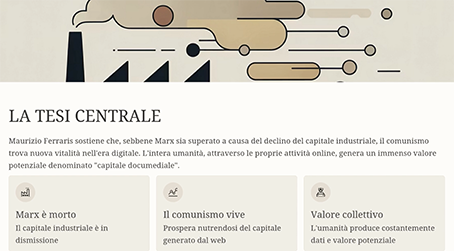
The whole of humanity produces data, i.e. potential value, on the web. However, the declining empire, the US, guarantees freedom, even if it means starving to death, but does not redistribute value, which remains in the hands of a very few. The rising empire, China, redistributes it, but – being a successful Bolshevik state – it limits freedom. To remedy America’s decline, President Trump wants to control the platforms, creating the masterpiece of a tyranny without redistribution. Is there a fourth way? Of course, digital communism, as explained in this book. The time is ripe; let’s not wait for it to rot.


