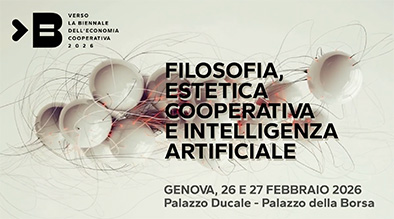
Biennale dell’Economia Cooperativa. An interview with Tania Cerquitelli
YouTube, February 26th, 2026
The development of digital platforms as a public good was one of the key themes of the Biennale dell’Economia Cooperative in Genoa on February 26, 2026. In line with Legacoop’s goals of promoting equitable innovation, Tania Cerquitelli, professor at the Polytechnic University of Turin, illustrates the “Data Cooperative” model. Her analysis explains how the collective and transparent sharing of information can generate social value greater than the sum of its parts, transforming data from a private asset into a common resource for the democratic governance of technology.

War Room. Con Marco Bentivogli, Giuliano Noci e Maurizio Ferraris
InConTraSrl, YouTube, December 18th, 2025
Artificial intelligence offers us the opportunity to transform our economy in 2026, the year of the new Made in Italy. Enrico Cisnetto discusses this with Marco Bentivogli, National Coordinator of Base Italia, Giuliano Noci, Professor of Strategy & Marketing and Deputy Rector of the Chinese Territorial Center at the Milan Polytechnic, authors of the manifesto “AI: Re-Made Italy, the Manifesto for the New Italian Manufacturing,” and Maurizio Ferraris, Professor of Theoretical Philosophy at the University of Turin, author of “Digital Communism. A Political Proposal” (Einaudi).
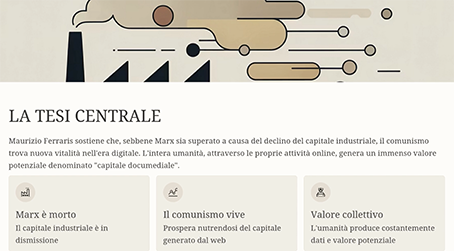
One book at a time – “Digital Communism” by Maurizio Ferraris
See you at the library, YouTube, December 2nd, 2025
The whole of humanity produces data, i.e. potential value, on the web. However, the declining empire, the US, guarantees freedom, even if it means starving to death, but does not redistribute value, which remains in the hands of a very few. The rising empire, China, redistributes it, but – being a successful Bolshevik state – it limits freedom. To remedy America’s decline, President Trump wants to control the platforms, creating the masterpiece of a tyranny without redistribution. Is there a fourth way? Of course, digital communism, as explained in this book. The time is ripe; let’s not wait for it to rot.

Keynote speeches
Mexico City, November 28th, 2025
Maurizio Ferraris and Jimmy Hernández Marcelo on digital technology
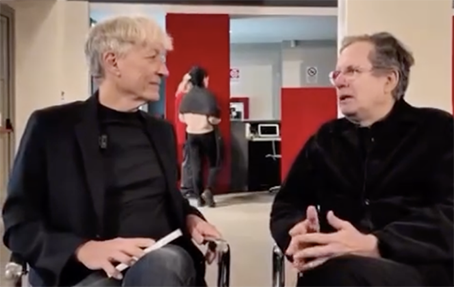
Has something gone wrong with the digital revolution?
Riccardo Luna, Instagram, November 14th, 2025
Labont Video Gallery
Maurizio Ferraris talks with Riccardo Luna

The Skin. From Artificial Intelligence to Reason
Mimesis Festival, YouTube, November 9th, 2025
The recording of Maurizio Ferraris’ lecture at the Mimesis Festival on November 1st, 2025, is now available
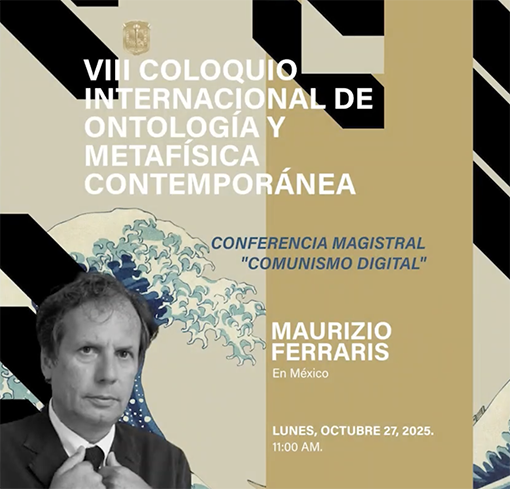
Keynote lecture: Digital Communism
International Colloquium on Ontology and Metaphysics, YouTube, October 30th, 2025
Inaugural Lecture of the VIII Colloquium on Ontology and Metaphysics by Maurizio Ferraris. Held on Monday, October 27th, 2025, in the Department of Philosophy at the University of Guanajuato. Project carried out under the framework of the CIEVENTOS-2025-48 project. “The current enclaves of ontology” sponsored by the Secretariat of Science, Humanities, Technology, and Innovation (SECIHTI)

Quante storie. “What is technique?”
Rai 3, October 24th, 2025
Director: Graziano Paiella
Host: Giorgio Zanchin
We are convinced that our era is dominated by technology. But is this really the case? When did technology come about and how does it affect our lives? Political scientist Carlo Galli and philosopher Maurizio Ferraris answer these questions in an episode of Quante Storie that addresses the problems arising from the use of artificial intelligence and the profits that large companies derive from the use of personal data.
Hybrid Intelligence. FestivalFilosofia
YouTube, September 30th, 2025
Recording of the lecture delivered on September 19th, 2025 in Sassuolo by Maurizio Ferraris, Hybrid Intelligence. Paideia between Nature and Culture. How did artificial intelligence change the formation of the human being? This lecture reflected on the meaning of the concepts of “intelligence” and “artificial,” showing how AI was not an autonomous subject but a repository of human knowledge, and how this entailed an educational responsibility to recognize in it the reflection of our own cognitive capacities.
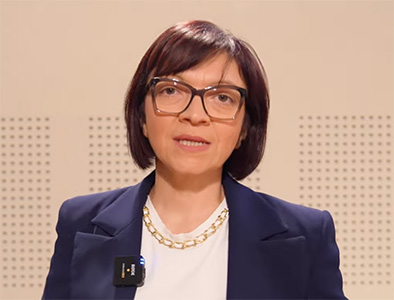
Webfare: Tania Cerquitelli and the pervasiveness of AI algorithms in modern society
YouTube, May 22nd, 2025
As part of the conference “What is to be done? Webfare! Humanism and technology for difficult times,” organized by the University of Turin on May 22, 2025, in the Aula Magna della Cavallerizza, Tania Cerquitelli, professor of Information Processing Systems at the Polytechnic University of Turin, discusses the impact and pervasiveness of Artificial Intelligence algorithms in modern society.
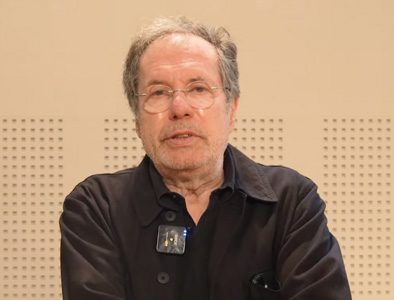
Webfare: Maurizio Ferraris and digital welfare
YouTube, May 22nd, 2025
As part of the conference “What is to be done? Webfare! Humanism and technology for difficult times,” organized by the University of Turin on May 22, 2025, in the Aula Magna della Cavallerizza, Maurizio Ferraris, professor of Philosophy at the University of Turin and president of Scienza Nuova, discusses the concept of digital welfare, or webfare.

Media Coverage

Data and Cooperatives: Generating Social Value from Artificial Intelligence. Interview with Tania Cerquitelli.
Daniele Molteni, Pandora Rivista, March 4th, 2026
The two-day national event Filosofia, Estetica Cooperativa e Intelligenza Artificiale, held in Genova and part of the Biennale dell’Economia Cooperativa promoted by Legacoop was dedicated to building a different “episteme” of artificial intelligence.
This interview with Tania Cerquitelli, Full Professor of Computer Science at the Politecnico di Torino, and member of PoliTO University Center for Social Welfare, explores the topic of data cooperatives and the prospects for an artificial intelligence model geared toward the common good, her speech highlighted the topic of the so-called “invisible inequalities” generated by algorithms.
Marx is dead, long live capitalism, even in the digital world
Stefano Da Empoli, HuffingtonPost, December 9th, 2025
The third way between the US liberal model and China’s dirigiste model in the highly sensitive issue of data management involves a voluntary scheme that allows the data donated by participants to be exploited and used to build services. The main proceeds of which should go to social purposes. A proposal (and three observations)
Marx is dead, communism is alive. This premise, which overturns what was said immediately after the fall of the Berlin Wall, is the starting point for the latest book, Comunismo Digitale (Digital Communism), published by Einaudi, by Maurizio Ferraris, a renowned philosopher who has repeatedly tackled digital technologies, both in numerous essays and in the WEBFARE – Web Fairness and Resilience project.

Artificial intelligence and digital communism
Oronzo Mazzotta, 9Colonne, November 28th, 2025
When, in January 1914, Henry Ford, the American automotive industry magnate, introduced a restructuring plan whose key points were a reduction in working hours (from nine to eight hours per day) and a pay rise for his workers that more than doubled their wages, the idea was met with great skepticism. Nevertheless, the idea produced more than positive results for the car manufacturer: increased productivity, reduced turnover, the disappearance of absenteeism and, above all, an increase (rather than a decrease) in profits…
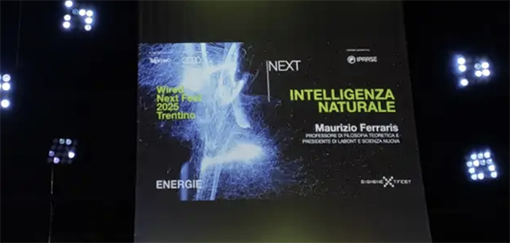
Natural intelligence
Anna Miotto, L’Universitario, November 20th, 2025
Artificial intelligence has now become a tool for everyday use and, at the same time, a subject of debate: some fear only the risks, trapped in fears sometimes fueled by the great classics of dystopia present in the collective imagination; others, on the contrary, see AI as an ally of man’s natural intelligence; and those who take a middle ground, focusing on the use – good or bad – that humans can make of artificial intelligence. These considerations, and more, were the subject of critical analysis and reflection at the Wired Next Fest, held in Rovereto over three days of conferences and workshops from October 3rd to 5th.
Among the guests invited to reflect on the topic was Maurizio Ferraris, professor of theoretical philosophy at the University of Turin and president of Labont and Scienza Nuova
Transforming web data into a new common good: the WEBFARE project is launched
Editorial staff, PoliFlash, November 17th, 2025
Every day, through our online actions, we produce an enormous amount of data. Words, images, preferences, movements: everything is recorded, archived, and transformed into value. A value that today is concentrated in the hands of a few global platforms, but that tomorrow could become a common, equitable, and shared good. This is the vision of WEBFARE, a research project conducted in collaboration with the University and Polytechnic of Turin, which has obtained €1.53 million in funding from the Ministry of University and Research (MUR) thanks to the Italian Fund for Applied Sciences (FISA), established in 2022 to promote the competitiveness of the national production system through the enhancement of industrial research and experimental development. Jointly coordinated by Maurizio Ferraris, professor at the Department of Philosophy and Education Sciences at the University of Turin, in the role of principal investigator, and Tania Cerquitelli, professor at the Department of Automation and Computer Science at the Polytechnic, in the role of co-principal investigator, the WEBFARE project addresses one of the most urgent challenges of our time: transforming data capital into human capital, giving people back the value they themselves generate with their digital lives.

Redistributing the value of data: digital communism in practice
Jimmy Hernández Marcelo and Pauldin Lawrence, Digital Agenda, November 19th, 2025
Digital communism proposes to redistribute the value of user-generated data, which is currently concentrated in Big Tech. The Webfare project puts theory into practice, with privacy-by-design technologies and governance capable of balancing social welfare, individual autonomy, and public-private innovation. The concept of digital communism proposed by Maurizio Ferraris draws attention to the possibility of using the value of digital data (big data) for the benefit of humanity as a whole.
A “Webfare” to turn data into the common good
Davide Gianluca Bianchi, Avvenire, November 15th, 2025
The first act of Leo XIV’s papacy was to assert the need to protect humanity from digital alienation, just as Leo XIII wanted to protect workers from industrial alienation. Thus begins Digital Communism: A Political Proposal by Maurizio Ferraris. The theme is the ‘fair redistribution of the value that humanity produces in its interaction with digital technology in all its forms through alternative capitalization’ as opposed to US capitalism, where everything is the preserve of private Big Tech companies, which are anything but open source, and Chinese capitalism, where the party distributes profits to the people but, at the same time, controls them obsessively to repress dissent. According to Ferraris, in the old continent, it would be possible to combine individual freedom and social justice by developing a different sensibility that the author calls Webfare, in analogy to social welfare, since every European citizen has the right to ask platforms for the data they produce on the web.

The Child Foundation presents Pope Leo XIV with a manifesto on the protection of minors in the age of AI (S.C.).
Editorial staff, Faro di Roma, November 12, 2025
In an era in which artificial intelligence shapes language, relationships, and even the collective imagination, the Child Foundation is relaunching a global appeal to defend the dignity of children in the digital world. Tomorrow, in the Vatican, the new Human Pact for the Digital Age will be presented to Pope Leo XIV as a symbol of a shared commitment to restore ethical and spiritual centrality to the relationship between technology and childhood.
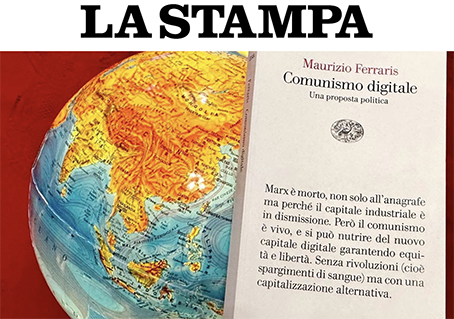
Maurizio Ferraris: “I dream of a communism without expropriation and violence that pays for our data.”
Francesco Rigatelli, La Stampa, November 12th, 2025
A sincere communist political proposal, but digital.” Maurizio Ferraris, 69, full professor of theoretical philosophy at the University of Turin, describes it briefly in his essay, aptly titled Digital Communism (Einaudi): an attempt to pool the fruits of big data in the age of web oligopolies and AI.
What do you mean by digital communism?
It is the restitution to humanity of the potential value that it itself produces through its own activity, which is mainly consumption and not work, on the web.
Digital communism, Webfare, and Ferraris’s documedial revolution
Andrea Cauti, AGI, November 5th, 2025
In a book, the philosopher illustrates the project he has developed in recent years at the Scienza Nuova institute (which brings together the University and Polytechnic of Turin) to create platforms that use data produced by all users to improve their living conditions.
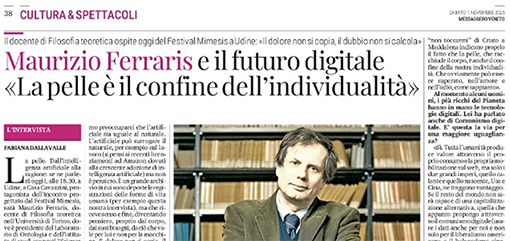
Maurizio Ferraris and the digital future
Fabiana Dallavalle, Messaggero Veneto, November 1st, 2025
The skin is the boundary of individuality.

Natural Intelligence: Our Skin, Our Mind, the Boundary with Machines
Trentino Press Office, October 4th, 2025
At WIRED Next Fest Trentino 2025, the philosopher Maurizio Ferraris brought back to the center of the discussion a theme often overlooked in debates on artificial intelligence: the specificity of human experience. In an era in which algorithms and digital systems seemed capable of learning, deciding, and even simulating convincing conversations, Ferraris invited reflection on what machines could not replicate-the bodily dimension, vulnerability, and the capacity to feel and to suffer. These elements, which constituted natural intelligence, marked, according to the philosopher, the ultimate boundary between human beings and machines and made necessary a more critical and conscious reflection on the way we interacted with AI.
Maurizio Ferraris’s Digital Alternative for Rethinking Power
Javier Correa Román, Filosofía&co, September 26th, 2025
The Italian philosopher Maurizio Ferraris took part in the second edition of the Festival of Ideas, which had recently been held in Madrid. On the occasion of his visit, we spoke with him about his proposal of digital communism, an alternative to data capitalism that invited a rethinking of power in the age of algorithms.

Dead for a Long Time: A Hypothesis of Digital Communism Resurrected from the Rubble of the Berlin Wall
Gianfranco Cordi, Calabria Post, October 19th, 2025
“Returning to humanity what humanity itself has produced is communism,” but it was also a “mythology.” In his book Digital Communism. A Political Proposal (Einaudi), Maurizio Ferraris proposed making use of this mythology within the present “change of the times.” What, then, had occurred today? An “objective change in the real technological configuration” had taken place, causing a “revaluation of values” whose “soul” was meant to be the founding myth of this new communism: “the reappropriation of what belongs to us.” Yet the communism associated with this “political proposal” was of a particular kind: it was “digital.” To achieve and implement it, we did not need to take to the streets and raise our fists but, essentially, to click on some app.
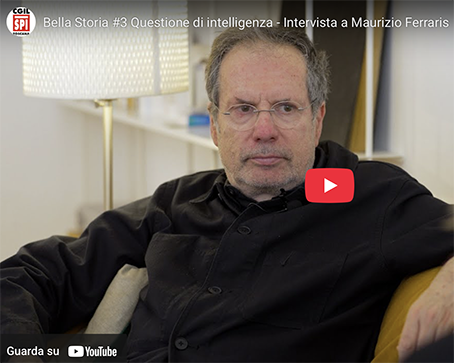
Bella Storia #3. The Video Interview with Maurizio Ferraris on Artificial Intelligence
September 4th, 2025
Who was afraid of artificial intelligence? How did this ingenious system work? What truly distinguished human beings from machines? In the third episode of Bella Storia – Encounters, People, Experiences, Daniela Morozzi met with Maurizio Ferraris, one of Italy’s most authoritative thinkers, to explore our relationship with technology.
Webfare. The Data of the Web Is Gold. Europe Must Start from Here for a “Digital Welfare”
Maurizio Ferraris, Corriere della Sera, August 11th, 2025
Many have been asking themselves this in recent days: how is it possible that a confederation of 450 million inhabitants, the world’s third-largest economy, finds itself on its knees on a golf course in Scotland before two of the world’s great powers, the United States and China?